
Cookie consent banners are supposed to protect websites from privacy lawsuits. Instead, they've become the primary target. When a user clicks "Reject All" but tracking pixels keep firing anyway, that's not just a technical glitch—under the California Invasion of Privacy Act (CIPA), it's potential wiretapping with $5,000 statutory damages per violation.
How bad is the cookie consent lawsuit problem?
The numbers tell the story: 4 federal cookie banner lawsuits were filed in late 2024. That jumped to 40 in 2025, and 49 so far in 2026. But the federal cases are just the visible edge. Over 1,000 lawsuits alleging CIPA violations were filed in 2025 alone, and 2026 is projected to exceed 3,500 filings.
This isn't random litigation. Plaintiffs allege that websites continue to collect users' data and disclose it to third parties even after they click the "reject all" button. They're using automated scripts to catch the divergence between what your banner promises and what your back-end actually does.
What makes a cookie banner legally broken?
The core legal shift: enforcement has moved from asking if a banner exists to asking if it actually works. Lawsuits target "divergence"—situations where a website offers a "Reject All" button that, while visually satisfying, fails to actually stop the underlying code from firing.
A company might install a top-tier Consent Management Platform but fail to properly integrate it with their Tag Manager. The user clicks "Reject," the banner disappears, but the Meta Pixel or Google Analytics tag continues to record their behavior in the background.
Under both CIPA and Europe's General Data Protection Regulation (GDPR), that's treated as interception without consent. The Planet49 ruling from the EU's highest court established that consent is not validly constituted by a pre-checked checkbox which a user must deselect to refuse consent. Consent under GDPR must be the result of a user's active behaviour; pre-ticked boxes make it objectively impossible to ascertain whether the user has consented.
Europe's enforcement agencies didn't stop at checkboxes. France's data protection authority, CNIL, fined Google €150 million in 2021 for making it difficult for users to refuse cookies. In 2025, CNIL issued 83 sanctions worth around €486.8 million, including cookie violations against SHEIN (€150M) and Google (€325M).
Why are lawyers targeting cookie banners now?
CIPA claims can result in statutory damages of $5,000 per violation. When you multiply that across a class, that's really significant exposure. Unlike other privacy cases that require proving actual harm, statutory damages are automatic.
These suits require less technological sophistication than other privacy lawsuits. As long as you have somebody with the appropriate technical background, you can easily examine whether the banner is up, what it says, and whether it causes the user's experience to be consistent with whatever choice the user elects.
Website architecture changes over time. Campaigns start and end. Things get added; others removed. It happens more than you might think. Since a cookie banner does not necessarily impact the core functionality of the site, months, if not years, may pass before there is any indication that it is not operating as intended. And the longer the problem persists, the greater the number of putative class members who may be impacted.
Even temporary malfunctions carry real risk. In the Todd Snyder settlement, regulators found that a misconfigured cookie consent banner prevented consumers from opting out for an extended period—a reminder that even short-term failures create liability.
Does your reject button actually reject?
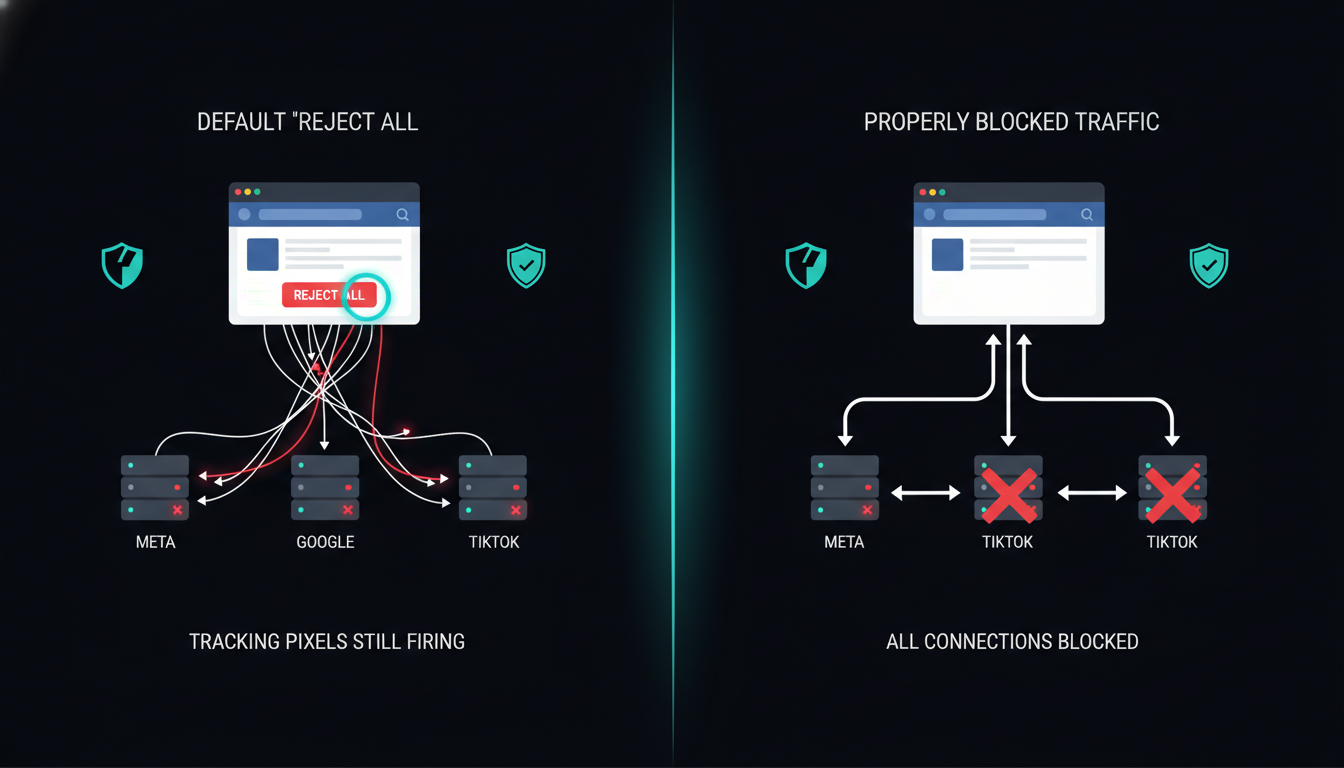 Technical diagram comparing broken vs working cookie consent implementation with network traffic visualization
The lawsuits expose three failure modes that trap well-meaning site operators:
1. Pre-consent tracking. Third-party scripts load immediately before the user clicks "Accept." Meta, TikTok, or Google pixels collect data before consent. Lawyers argue the interception occurred before consent, and it violates CIPA.
2. Dark patterns that steer consent. Visual hierarchy pressures users when "Accept All" appears prominent while "Reject" requires clicking "Settings." The CPRA symmetry principle and EDPB Cookie Banner Taskforce Report require identical button size, color saturation, and visual weight. A neon-green "Accept" next to a tiny gray "Reject" link isn't neutral design—it's coercion by UI.
3. Opt-outs that don't stop tags. CNIL found cookies placed before any user choice was made, cookies placed despite an explicit refusal, and cookies that kept running after consent was withdrawn. Withdrawal must actually work—not just record a preference while cookies continue to fire.
If you installed a consent banner from a template marketplace or via a quick plugin without testing the tag blocking, you're in the high-risk group. Scan your site free to see what's loading before consent is granted.
What regulators actually require now
The European Data Protection Board's Cookie Banner Taskforce set the standard in 2023. SAs will assess each cookie banner case-by-case taking into account its color and format. Users should receive clear information about the cookies used, the purposes, and the means to consent and/or reject. Users who consent should be able to withdraw that consent at any time. It should be as easy to withdraw consent as it is to give it.
Multiple national regulators now go further. Belgium, Netherlands, and Germany now explicitly require a "Refuse" button on the first layer of the banner. California's attorney general is watching too—the state that drove over 1,000 CIPA filings in 2025 alone.
A "Reject All" button must be present on the first layer with equal prominence to the "Accept All" button. Not buried in settings. Not a text link while "Accept" is a button. Same size, same visual weight, same number of clicks.
And your Consent Management Platform must actually block tags until consent is granted—not just show a banner while scripts run in the background. The Google Analytics & Ads consent mode changes rolling out this year make this even more urgent.
The punchline
Cookie consent was supposed to solve the privacy problem. Instead, it created a second one: thousands of websites now promise choice they don't technically deliver. The banner says "Reject," the tag manager says "fire anyway," and the lawsuit says "see you in court."
Plaintiffs are not targeting any specific type of defendant or industry. They have brought claims against retailers, telecommunication providers, hospitality companies, fast-food chains, media companies, beverage producers. The only common thread: they had a public-facing website and their cookie banner was not operating as intended.
You thought compliance was installing a plugin. It's actually testing whether that plugin stops your tracking stack when users say no. Most sites haven't done that test. The plaintiff's bar has.
Frequently Asked Questions
What is a cookie consent banner and why is it legally required?
A cookie consent banner informs users that your website uses cookies and requests permission before placing non-essential tracking cookies. It's required under GDPR in Europe, state privacy laws like CCPA in California, and similar regulations worldwide to ensure users can control their data.
Can I be sued if my cookie banner has a reject button but tracking still happens?
Yes. Lawsuits allege that websites continue to collect data even after users click "reject all". Under CIPA, this can be treated as wiretapping with $5,000 statutory damages per violation, and class actions are surging.
Do I need a reject button on the same screen as the accept button?
A "Reject All" button must be present on the first layer with equal prominence to the "Accept All" button. Hiding rejection in a settings menu violates the principle that refusing consent must be as easy as granting it.
What is the Planet49 ruling and why does it matter for cookie consent?
The Planet49 case from the EU's Court of Justice established that consent is not validly constituted by a pre-checked checkbox. Users must take active steps to consent—silence or pre-ticked boxes don't count.
How do I know if my cookie banner actually blocks tracking when users reject?
Use your browser's developer tools to monitor network requests, or run an automated scan. Click "Reject All" and check whether Google Analytics, Meta Pixel, or other third-party scripts still fire. If they do, your banner is broken and you're exposed to lawsuits.
Are cookie consent lawsuits only happening in California?
No. While over 1,000 CIPA lawsuits were filed in California in 2025, Europe is aggressively enforcing too. France's CNIL issued 83 sanctions worth €486.8 million in 2025, many for cookie violations. Any site with EU or California users is in scope.