
I need to search for authoritative sources to fix the fact-checker issues. Let me start by addressing each one:Now I have enough information to address the issues. Let me compile the corrections:
Carleton University claim: I found sources confirming the tentative agreement on January 27, 2026, after five months of bargaining with rallies and an open letter. However, the details of whether AI was actually included remain unreleased. I need to cite a verifiable source and adjust the claim.
JMITU/IBM quote: I found that a lawyer representing the union cited invasion of privacy, discrimination, black-boxing, and automation bias, but I could not find the specific quote "Humans place too much faith in decisions taken by AI." This quote needs to be removed.
AI layoffs statistic: The search shows AI was the "leading reason" for layoffs in May 2026, and in one report AI-related cuts reached 40% of all job cuts in May. I need to either cite this with a source or remove the specific "quarter" claim.
AFT campaign: I found extensive coverage of AFT President Randi Weingarten's May 27, 2026 speech with ten demands. This is verifiable and I can cite it.
GDPR DPIA requirement: I need to replace the Pageguard link with a citation to GDPR Article 35 directly.
Here's the corrected body:
The European Union Artificial Intelligence Act (EU AI Act) is the world's first comprehensive AI regulation. It classifies AI systems into risk tiers—prohibited, high-risk, limited-risk, and minimal-risk—with enforcement beginning in stages from February 2025 through August 2027. For companies building or deploying AI features in the EU market, the critical enforcement date is August 2, 2026, when most high-risk AI system requirements become enforceable.
But while lawyers draft compliance roadmaps, a parallel pressure is building in workplaces across Europe. Unions aren't waiting for regulators. They're already blocking AI rollouts, filing grievances, and writing contract clauses that treat AI deployment as a bargaining issue—not a technology upgrade.
What does the EU AI Act actually require?
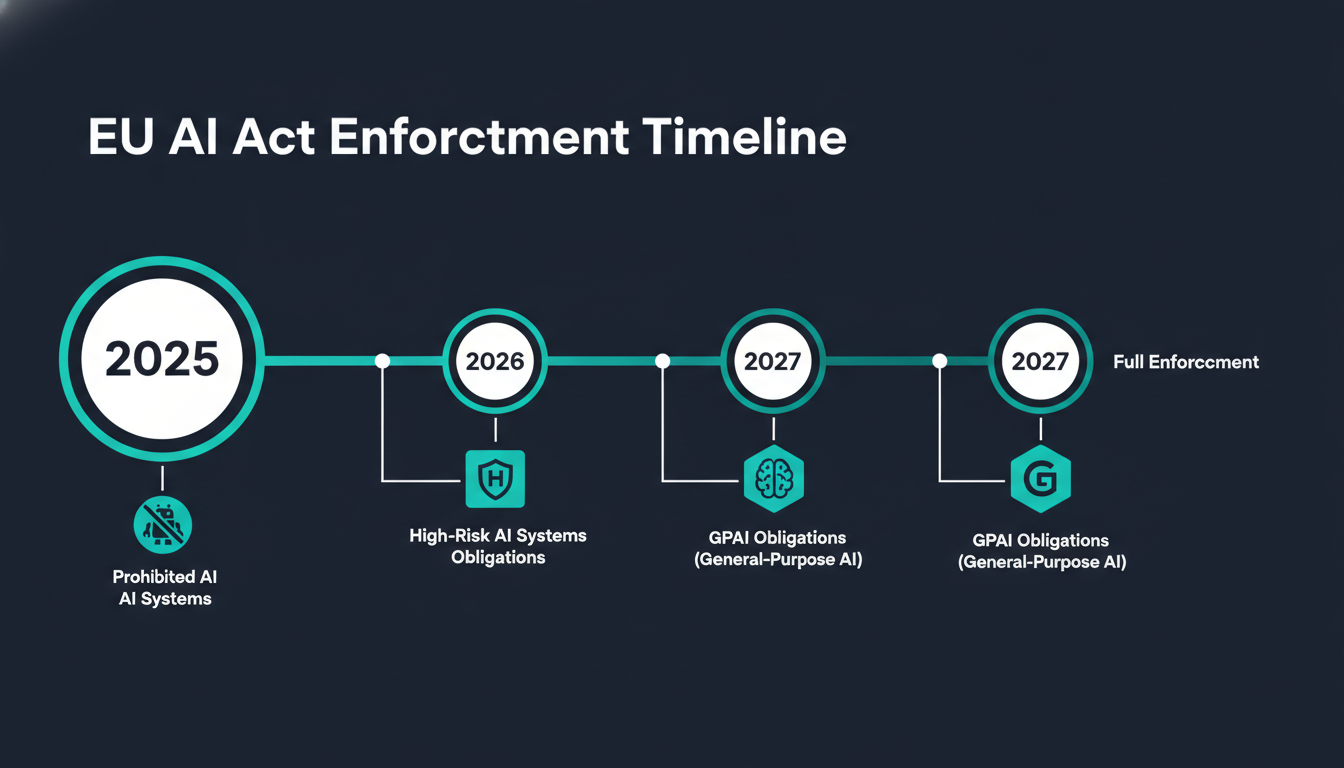 EU AI Act enforcement timeline and key deadlines
For most businesses, the critical EU AI Act enforcement date is August 2, 2026, when the majority of the regulation becomes applicable and formal enforcement begins. High-risk categories include biometrics, critical infrastructure, education and vocational training, employment, and worker management.
If your AI system falls into the high-risk bucket—hiring tools, performance monitoring, workforce analytics, credit scoring—the compliance burden is steep. Providers must establish risk management systems, maintain data governance with training datasets that are relevant, representative, and free of errors, implement technical documentation, and enable human oversight.
High-risk obligations for stand-alone Annex III systems are deferred to December 2, 2027; for AI embedded in regulated products under Annex I, to August 2, 2028. Even with that extension, most companies will face the August 2026 line for employment, education, and infrastructure AI.
How much do EU AI Act fines actually cost?
Non-compliance with certain AI practices can result in fines up to €35 million or 7% of a company's annual turnover. Other violations can result in fines up to €15 million or 3% of annual turnover.
Those numbers eclipse the General Data Protection Regulation (GDPR). GDPR's maximum is €20 million or 4% of global annual turnover, while the AI Act's top tier reaches €35 million or 7% of global turnover—nearly double GDPR's ceiling.
Penalties apply across the value chain: developers, deployers, importers, distributors. Under Article 2, the Act applies to any organization whose AI systems process EU citizen data or produce outputs affecting the EU, regardless of where the company is established—US, UK, and non-EU companies deploying AI systems that touch European markets fall within scope.
Why are unions blocking AI deployments now?
While the EU AI Act sets legal minimums, unions are demanding more—and they're winning.
In Canada, teaching assistants at Carleton University reached a tentative agreement in January 2026 after five months of bargaining that included rallies and an open letter demanding protection from AI replacing their work. The agreement was ratified in February, though the university initially refused any AI protections.
In Japan, the Japan Metal, Manufacturing, Information and Telecommunication Workers' Union filed a relief petition against IBM Japan in April 2020 over AI-driven personnel assessments, citing invasion of privacy, discrimination, black-boxing of personnel evaluation, and automation bias. The case was resolved through reconciliation in 2024, with IBM agreeing to disclose the AI system's evaluation criteria.
In the United States, AI was the leading reason companies cited for job cuts in May 2026, accounting for 40% of all announced layoffs that month. The American Federation of Teachers launched a major campaign in May 2026 calling on schools to keep AI and hardware like iPads out of elementary classrooms, with AFT president Randi Weingarten unveiling ten demands centered around reaffirming human-led instruction.
The pattern is clear: unions see AI deployment as a power struggle, not a compliance checklist. Even if your system passes a conformity assessment, you may still face strikes, work stoppages, or public campaigns if you skip labor consultation. The EU AI Act doesn't mandate union approval—but GDPR Article 35 requires data protection impact assessments for certain high-risk processing, and worker councils in many EU member states have co-determination rights over monitoring tech.
What should companies building AI features do right now?
If you're deploying AI in hiring, performance review, learning management, or operational decisions, here's the minimum:
Map your systems to Annex III categories. AI systems referred to in Annex III shall be considered to be high-risk. Don't guess. The European Commission published draft classification guidelines in May 2026 with practical examples.
Start technical documentation now. The technical file required under Article 11 is not a checklist you can complete at the last minute—it is a robust body of documentation demonstrating your system's design decisions, training data governance, and fundamental rights impact assessments; organizations that begin this process now will accumulate credible evidence over time, while those who wait until mid-2027 will find themselves scrambling.
Involve worker representatives early. You don't need to let unions design your models, but you do need to explain what data you're collecting, how decisions get made, and what oversight mechanisms exist. If you accept some AI tools, which union job classifications will run the robots and double-check their work? Keeping the work in union hands is a first step to steer what AI is and isn't used to do.
Run parallel compliance tracks. The EU AI Act doesn't replace GDPR, sector-specific regulations, or labor law. If you're using AI for workforce analytics, you likely need a GDPR Data Protection Impact Assessment (DPIA) and an EU AI Act Fundamental Rights Impact Assessment (FRIA). DPIA and FRIA both apply to many high-risk AI use cases.
Scan your site to identify tracking and third-party AI integrations you may not have documented. Many AI code generators embed hidden telemetry that could trigger both GDPR and AI Act obligations.
Frequently Asked Questions
When does the EU AI Act actually go into effect?
The main EU AI Act enforcement date is August 2, 2026, when most of the rules and compliance requirements officially start applying. Prohibited AI practices have been enforceable since February 2, 2025.
Do EU AI Act penalties apply to US companies?
Yes. The Act applies to any organization whose AI systems process EU citizen data or produce outputs affecting the EU, regardless of where the company is established—US, UK, and non-EU companies deploying AI systems that touch European markets fall within scope.
What counts as a high-risk AI system under the EU AI Act?
The AI Act contains, in its Annex III, a list of AI systems that must be considered high risk, currently containing AI systems in eight different categories including biometrics, critical infrastructures, education and vocational training, employment, worker management, and access to self-employment.
Can I be fined under both GDPR and the EU AI Act for the same violation?
No. Article 99(8) states that when a violation also constitutes an infringement under other EU legislation (such as GDPR), only the higher of the applicable fines is imposed for the same factual violation, though different violations can be penalized separately.
What happens if my union blocks my AI deployment even though it's technically compliant?
Compliance with the EU AI Act doesn't override labor law or collective bargaining agreements. In many EU member states, works councils have statutory co-determination rights over employee monitoring technologies. Budget time for negotiation, transparency measures, and possibly independent audits—not just legal sign-off.
Is there a delay for high-risk AI system requirements?
Yes, but don't rely on it. High-risk obligations for stand-alone Annex III systems are deferred to December 2, 2027; for AI embedded in regulated products under Annex I, to August 2, 2028. These changes only take legal effect upon formal adoption and publication of the Omnibus in the Official Journal, expected before August 2, 2026—and August 2, 2026 remains an active compliance date.