
What do GDPR fines reveal about enforcement priorities in 2026?
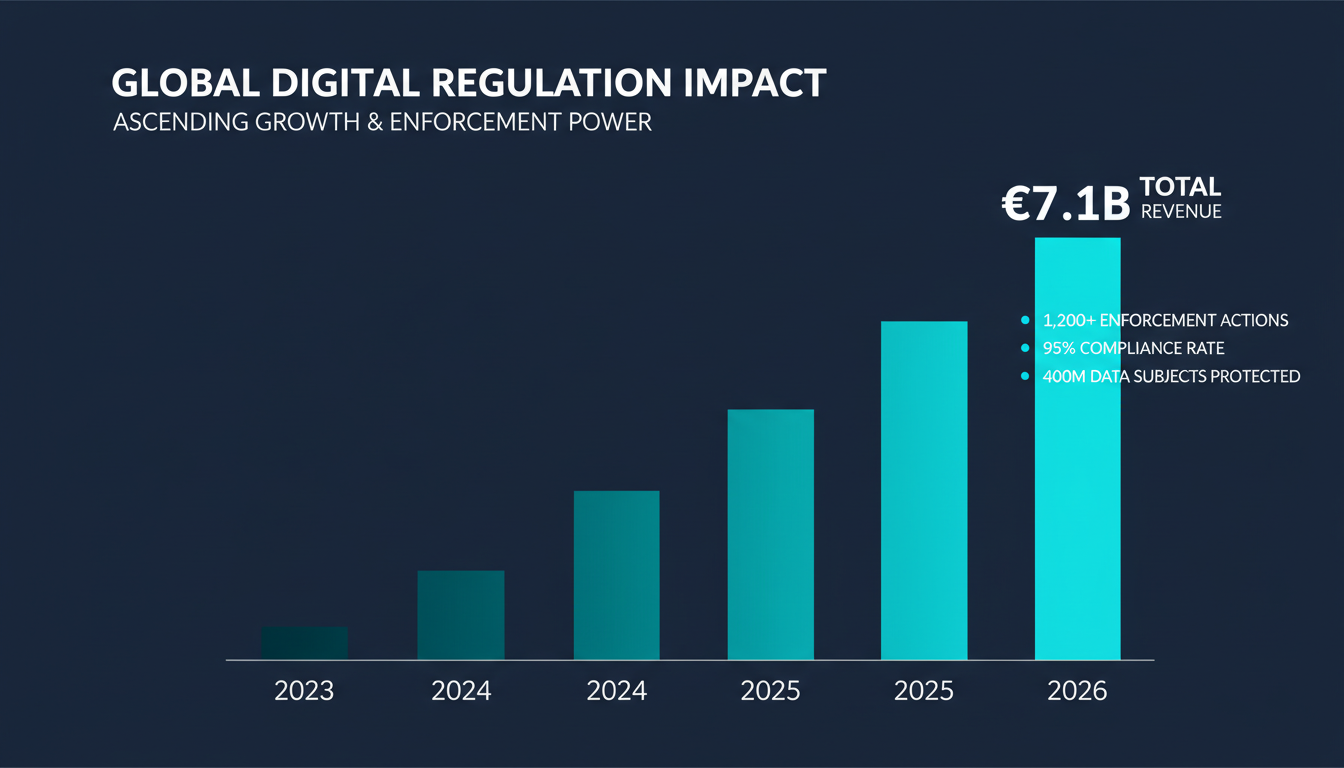 GDPR fines acceleration trend 2023-2026 showing enforcement ramp
The enforcement acceleration is undeniable. €7.1 billion in cumulative GDPR fines have been issued since May 2018, with €1.2 billion landing in 2025 alone—matching 2024's record. But the total is misleading. Between May 2018 and December 2022, roughly 40% of all fines were issued. Between January 2023 and March 2026? Regulators issued more fines than in the preceding five years combined.
This isn't a plateau. It's a ramp. And if you're building anything that touches EU user data—SaaS tools, marketing platforms, analytics dashboards—you need to understand exactly where the enforcement machine is pointing.
Which GDPR articles are regulators actually enforcing?
The fines data exposes three enforcement hotspots. Article 6 violations (legal basis for processing) account for one-third of all enforcement actions. If your service claims "legitimate interest" for analytics but can't document why that processing is necessary, proportionate, and less privacy-intrusive than alternatives, you're sitting on an Article 6 violation. Regulators are done with post-hoc justifications.
Second: Article 5(1)(a) and 5(1)(f)—covering lawfulness, fairness, transparency, and security—are now primary enforcement targets. These aren't procedural niceties. They're the foundational principles regulators evaluate when determining whether you treated data protection as a design principle or an afterthought. When France's CNIL fined Google €325 million in September 2025 for displaying Gmail ads without consent and manipulating cookie acceptance flows, they were signaling that dark patterns in consent UX are now systematically prosecuted.
Third: Cross-border data transfers (Article 46). The €530 million fine against TikTok in May 2025 for unlawful EU-China transfers confirms that transfer impact assessments aren't optional paperwork—they're scrutinized prerequisites.
Why is the EDPB launching a transparency enforcement sweep in 2026?
The European Data Protection Board selected transparency and information obligations (Articles 12-14) as its 2026 coordinated enforcement priority. During 2026, 25 Data Protection Authorities across Europe will assess whether controllers give individuals clear, complete, and accessible information about data processing.
This is coordinated, not coincidental. Previous EDPB actions targeting the right of access (2024) and right to erasure (2025) consistently surfaced the same problem: controllers fail to provide sufficient information to users about their rights. The 2026 sweep addresses that failure directly—and historically, coordinated actions result in a spike in related fines within 6-12 months.
If your privacy policy doesn't match what your site actually does—if you're loading third-party scripts not disclosed in your policy, or if your Article 14 notices (for indirectly collected data) are missing—you're precisely the compliance gap regulators will target. Now's the time to scan your site and verify what's actually running versus what's documented.
Are only Big Tech companies getting fined under GDPR?
No. Spain has issued nearly 1,000 GDPR fines since 2018—by far the highest volume—but the average penalty is small. Spain's enforcement pattern is high-frequency, distributed actions against organizations of every size. The misconception that only enterprises face enforcement is factually wrong: a significant share of all GDPR fines are issued to SMEs, regional service providers, and small SaaS companies.
The difference is headline visibility. A €10,000 fine against a regional agency doesn't make TechCrunch. But it still lands—and for a bootstrapped startup, it's existential. Regulators apply proportional severity, not exemption.
What's driving the 22% spike in breach notifications?
European data protection authorities now receive an average of 443 breach notifications per day—a 22% year-over-year increase, breaking the plateau trend for the first time since 2018. The spike reflects faster attacks, more sophisticated threat actors, and expanded notification obligations under overlapping regulations (GDPR, NIS2, DORA).
But here's the enforcement consequence: Article 5(1)(f)—the integrity and confidentiality principle—is now a primary fine trigger. When Ireland's DPC accounts for €4.04 billion in cumulative fines, much of that stems from systemic security failures, not isolated incidents. If your vendor management process can't demonstrate that processors have "appropriate technical and organizational measures" in place, you're inheriting their breach exposure—and their fine liability.
Developers pulling in SDKs via auto-installers or AI-generated boilerplate should read our analysis of privacy risks in AI-generated code and auto-installed SDKs. Every dependency is a processor relationship that GDPR Article 28 requires you to document and contractually govern.
What's the AI Act's impact on GDPR enforcement?
The EU AI Act reaches full enforcement for high-risk AI systems on August 2, 2026, with penalties up to €35 million or 7% of global turnover—substantially higher than GDPR's 4% cap. AI-driven targeting, audience modeling, and personalization will be re-examined under both frameworks simultaneously.
This creates a dual-penalty layer. If your feature uses ML models trained on user data, you need both a GDPR-compliant legal basis (likely consent or legitimate interest with a documented assessment) and AI Act-compliant risk classification, technical documentation, and human oversight. Italy's Garante is already treating large-model training data under the same legal-basis lens it applies to ad tech, signaling that AI processing won't get regulatory leniency.
What should developers and compliance teams do right now?
Three immediate actions reduce enforcement exposure:
First: Document your legal basis for every data processing activity. Article 6 violations account for one-third of enforcement. Your documentation must precede data collection—post-hoc justifications fail under audit. For every dataset, you need a contemporaneous record of why this legal basis, why this data, why this retention period.
Second: Audit your consent mechanisms. If your site uses cookie banners, test them. Verify consent is freely given, specific, informed, and unambiguous. If your "Reject All" button has more friction than "Accept All," that's a dark pattern—exactly what regulators are targeting in 2026. Use a cookie scanner to verify what's firing before versus after consent.
Third: Reconcile your privacy policy with actual data flows. The 2026 transparency sweep will expose mismatches between what you disclose and what you do. Map processing activities to vendor contracts, script inventories, and API calls. If third-party services collect data not mentioned in your Article 13/14 notices, close that gap before a DPA finds it.
The learning curve is over. The enforcement machinery is running. And the fines data tells you exactly where it's pointed.